How to Build a Grocery Delivery App: Features, Development Process, and Custom vs Readymade Comparison
Free Consultation
Talk to Our Experts
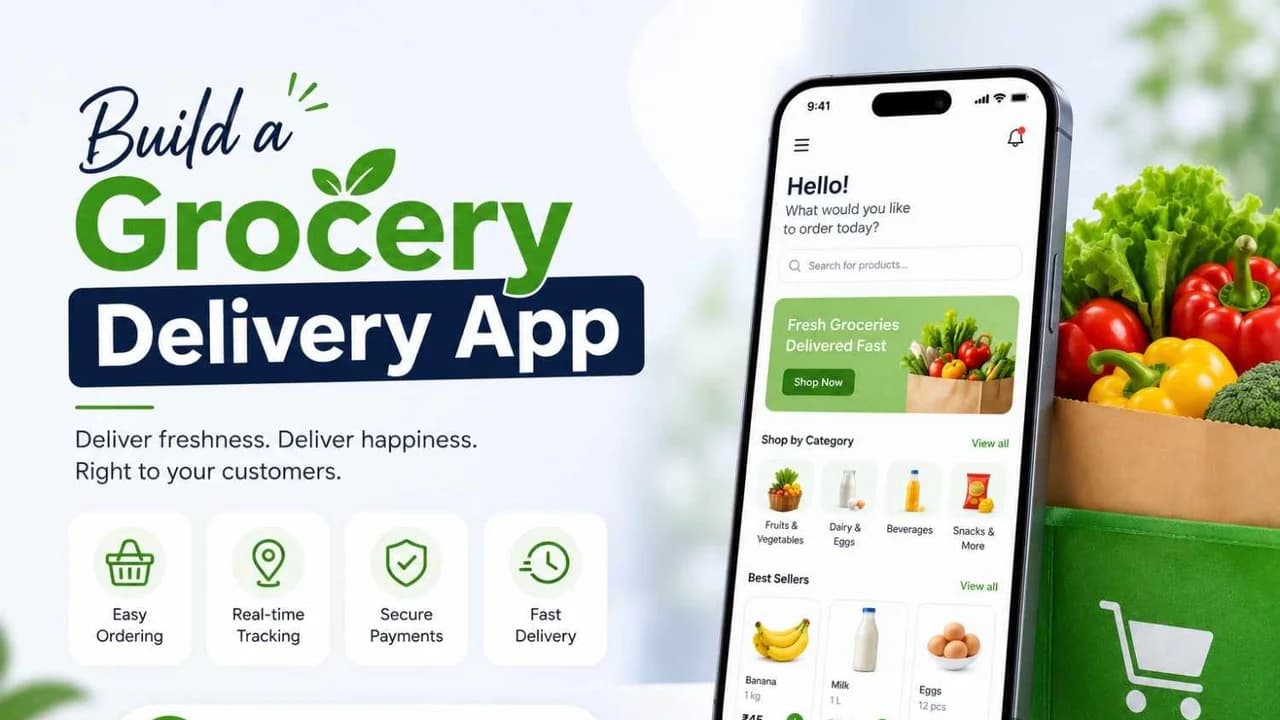
If you are searching how to make a grocery delivery app, the short answer is this. You need three connected pieces, a customer app, a delivery partner app, and an admin panel, along with core features like real time order tracking, inventory sync, and multiple payment options. Whether you want to create grocery delivery app software from scratch or you are trying to build grocery delivery app software on top of an existing platform, this guide walks through every stage so you can plan your project with a clear budget and timeline in mind.
Why Businesses Are Investing in Grocery App Development
Online grocery app development has grown fast because shopping habits shifted permanently after people got used to ordering essentials from their phone. A well planned grocery mobile app development project gives a business direct access to repeat customers instead of relying on a marketplace that takes a cut of every order.
Online grocery app development has grown fast because shopping habits shifted permanently after people got used to ordering…
Local grocery chains, supermarkets, and even single store owners are now looking into grocery delivery mobile app development because it lets them control pricing, delivery timing, and customer relationships without a third party in between. This is the biggest reason grocery app development has moved from a nice to have feature to a core part of retail strategy for small and mid sized grocery businesses across India.
Local grocery chains, supermarkets, and even single store owners are now looking into grocery delivery mobile app development…
There is also a data advantage that gets overlooked early on. Once a business runs its own app, it can see exactly what customers buy, how often they reorder, and which products sell fastest during specific hours. Marketplace platforms rarely share this level of detail, which means a business relying only on third party apps is missing insights that could shape stocking decisions, pricing, and promotions. Owning the app means owning the data, and that data becomes more valuable the longer the app stays active.
There is also a data advantage that gets overlooked early on. Once a business runs its own app,…
Must Have Features in a Grocery Delivery App
Before you commit to any grocery store app development project, make sure the plan covers these core features.
Product catalog and search. Customers should be able to browse by category and search by product name with autocomplete suggestions, since grocery lists often have dozens of small items.
Real time inventory sync. This is one of the hardest parts of grocery delivery application development, because stock changes constantly. Without live sync between your store inventory and the app, customers order items that are out of stock, which damages trust fast.
Real time inventory sync. This is one of the hardest parts of grocery delivery application development, because stock…
Multiple payment options. Cash on delivery, UPI, cards, and wallets should all be supported, since grocery buyers use a wide mix of payment methods depending on order size.
Delivery slot selection. Letting users pick a delivery window rather than a vague estimate improves satisfaction significantly, especially for online grocery application users ordering for the week.
Order tracking and notifications. A live map showing the delivery partner's location, paired with push notifications at each stage, keeps users informed without them having to open the app repeatedly.
A strong online grocery website development project pairs all of this with a responsive web version too, since not every customer wants to download an app for occasional orders.
Grocery Delivery App Development Process, Step by Step
On demand grocery delivery app development follows a structured path when done properly. Here is what that process actually looks like.
Discovery and planning. The development team maps out your specific business model, whether that is single store delivery, multi store aggregation, or a hybrid model with your own dark stores.
Feature scoping. This is where grocery app development services teams define exactly which features go into version one and which get pushed to a later release, so the project stays on budget and on schedule.
UI and UX design. Screens are designed around fast checkout, since grocery shopping is a repeat, low friction task compared to one time purchases.
Backend and API development. This stage covers inventory management, order routing, payment gateway integration, and delivery partner assignment logic.
Testing across devices. A reliable grocery ordering app development partner tests the app across different phone models, network speeds, and payment gateway edge cases before launch.
Launch and post launch support. Once live, ongoing monitoring catches bugs early and keeps the app compatible with new OS updates.
If you are comparing vendors, ask for a breakdown of exactly what falls under grocery delivery app development services in their proposal, since some companies quote a low number that only covers the customer facing app and leaves out the delivery partner app and admin panel entirely. Any serious grocery ordering app development company should include all three from the start.
If you are comparing vendors, ask for a breakdown of exactly what falls under grocery delivery app development…
Custom Grocery App Development Versus Readymade Solutions Versus App Builders
This is the decision most business owners get stuck on, so it helps to separate the three paths clearly.
Custom grocery app development means the app is built from the ground up around your specific business rules, your store locations, your delivery zones, and your existing systems. This path costs more and takes longer, but it gives you full ownership of the code and complete flexibility as your business grows.
Custom grocery app development means the app is built from the ground up around your specific business rules,…
A readymade grocery app is a pre built solution that gets configured with your branding, product catalog, and store details. This works well for businesses that want to launch quickly with a proven feature set and do not need heavy customization right away.
A readymade grocery app is a pre built solution that gets configured with your branding, product catalog, and…
An online grocery store builder or grocery app builder takes this a step further, offering a drag and drop interface where you set up your store without needing a development team at all. These tools are useful for very small operations testing the market, but they usually hit a ceiling once your order volume grows or you need custom logic like zone based pricing.
An online grocery store builder or grocery app builder takes this a step further, offering a drag and…
Some businesses also look at general grocery shop software platforms that combine point of sale and delivery features in one system. This can work for a single location store, but multi location businesses usually outgrow these platforms quickly.
If you are trying to decide whether to build grocery app software custom or go with a readymade option, the honest answer depends on your timeline and long term plans. A readymade solution gets you live in weeks. Custom development takes longer but avoids the limitations you will eventually hit with a template based system.
If you are trying to decide whether to build grocery app software custom or go with a readymade…
Grocery Delivery Management, Backend Essentials
Good grocery delivery management is what separates apps that scale from apps that fall apart under real order volume. This includes automated delivery partner assignment based on proximity, route optimization so partners handle multiple orders efficiently, and a dashboard that gives store owners visibility into every order in real time.
Good grocery delivery management is what separates apps that scale from apps that fall apart under real order…
This backend work matters just as much as the customer facing app. A polished grocery shopping app development project can still fail if the operations side cannot handle order spikes during peak hours like evenings and weekends, when most grocery orders come in within a short window.
This backend work matters just as much as the customer facing app. A polished grocery shopping app development…
How to Choose a Grocery App Development Company
Once you understand the features and process, the final step is picking the right partner. Here is what to check.
Ask for live examples, not just mockups, from any grocery delivery app development company you are considering. A company that has only built demo projects will struggle with real world issues like inventory sync delays and payment gateway failures.
Check their experience across business models. A grocery app development company that has handled single store, multi store, and dark store models understands how differently each one needs to be architected.
Confirm ownership terms. Ask any grocery delivery app developer directly whether you get full source code ownership once the project is delivered, since some vendors keep partial control to lock you into ongoing fees.
Review their post launch support plan. A grocery app developer worth hiring should offer clear terms for bug fixes, feature updates, and scaling support as your order volume grows.
Talk to more than one team. Comparing a few grocery app developers side by side helps you spot vague answers versus teams that clearly understand the operational side of grocery delivery app development, not just the coding side.
Common Mistakes to Avoid When Building a Grocery App
A few mistakes show up repeatedly in grocery app projects, and knowing them upfront can save significant time and budget.
Underestimating the admin panel. Many businesses focus heavily on the customer app and treat the admin panel as an afterthought, only to realize later that store staff struggle to manage orders, update stock, or handle cancellations without a proper dashboard.
Ignoring offline scenarios. Delivery partners often move through areas with weak network coverage. An app that cannot handle brief connectivity gaps, or that loses order data during a dropped connection, creates real problems during actual deliveries.
Skipping load testing before peak hours. Grocery orders spike heavily during evenings and weekends. An app that works fine during a demo can slow down or crash entirely once real order volume hits during these peak windows, so load testing before launch is not optional.
Skipping load testing before peak hours. Grocery orders spike heavily during evenings and weekends. An app that works…
Choosing features over reliability. It is tempting to add every feature at once, but a smaller set of features that work reliably will always perform better than a long feature list built on a shaky foundation. Start with the essentials and expand once the core system proves stable.
Choosing features over reliability. It is tempting to add every feature at once, but a smaller set of…
Final Thoughts
Building a grocery delivery app is less about picking the fanciest features and more about matching the right development path to your business stage. Whether you choose custom development, a readymade platform, or an app builder to get started, the goal stays the same, giving your customers a fast, reliable way to order and giving your team the tools to manage deliveries without chaos. Take time to map your process clearly before you approach any development partner, since a well defined plan is what actually keeps a grocery app project on budget and on time.
Building a grocery delivery app is less about picking the fanciest features and more about matching the right…
Frequently Asked Questions
Question
How do I create a grocery delivery app?
⌄
Answer
Start by defining your business model, whether single store or multi store, then plan the three core apps, customer, delivery partner, and admin, before choosing between custom development and a readymade solution based on your budget and timeline.
Question
Is it better to build a custom grocery app or use a readymade solution?
⌄
Answer
Readymade solutions get you live faster and cost less upfront, while custom development gives you full flexibility and ownership as your business grows. Choose based on how quickly you need to launch and how specific your operational requirements are.
Question
How long does it take to build a grocery delivery app?
⌄
Answer
A basic version with core features typically takes eight to twelve weeks, while a more advanced app with route optimization and multi store support can take four to six months depending on complexity.
Question
Do I need a separate app for delivery partners?
⌄
Answer
Yes, a dedicated delivery partner app with route guidance and order status updates is essential for smooth operations, and skipping this usually leads to delivery delays and poor customer experience.