Website Development04 May 2026
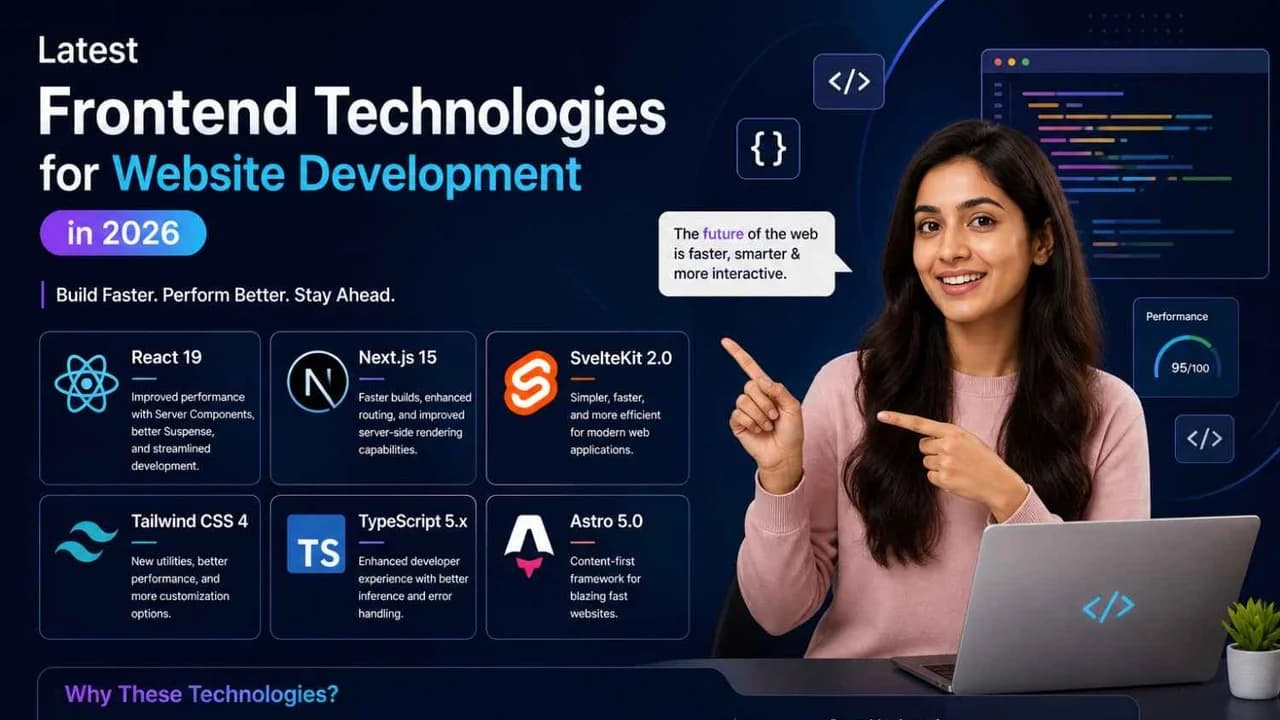
Latest Frontend Technologies for Website Development in 2026
Free Consultation
Talk to Our Experts
Modern Frontend Technologies That Drive Better Website Performance
The frontend development landscape has transformed dramatically over the past few years. Businesses today demand websites that load instantly, work flawlessly on mobile devices, and deliver exceptional user experiences. Choosing the right frontend technology stack is no longer just a technical decision it directly impacts your website's performance, search rankings, and business growth.
Whether you're planning to build a new website or modernize an existing one, understanding the latest frontend technologies will help you make informed decisions that align with your business goals.
What Are Frontend Technologies
Frontend technologies refer to the programming languages, frameworks, and tools developers use to build the visual and interactive parts of a website that users see and interact with. While backend handles server-side operations and databases, frontend focuses on user interface, animations, responsiveness, and overall user experience.
Modern frontend development goes beyond simple HTML and CSS. Today's websites require sophisticated frameworks that can handle complex state management, dynamic content updates, real-time data synchronization, and seamless navigation without page reloads.
Why Modern Frontend Technologies Matter for Your Business
Traditional website development approaches are no longer sufficient for today's competitive digital landscape. Modern frontend technologies offer several critical advantages:
Performance Optimization: Latest frameworks like Next.js and Astro deliver lightning-fast page loads through server-side rendering and static site generation. Google prioritizes fast websites in search rankings, making performance a direct SEO factor.
Mobile-First Experience: With over 70% of Indian internet users accessing websites through mobile devices, responsive design is mandatory. Modern frameworks come with built-in mobile optimization capabilities.
Scalability: As your business grows, your website needs to handle increased traffic and functionality. Component-based architectures allow developers to add features without breaking existing code.
Reduced Development Time: Pre-built components, extensive libraries, and active developer communities significantly reduce development timelines and costs.
React: The Industry Standard for Dynamic Web Applications
Why Choose React:
- React's virtual DOM efficiently updates only the changed elements instead of reloading the entire page. This results in significantly faster interactions and better user experience. Major platforms like Facebook, Instagram, Netflix, and Airbnb rely on React for their frontend infrastructure.
- The React ecosystem offers an extensive collection of ready-to-use component libraries like Material-UI, Ant Design, and Chakra UI. These libraries provide professionally designed components that can be customized to match your brand identity, saving months of development time.
- For businesses in India targeting both local and international markets, React's flexibility in handling multilingual content and internationalization makes it an ideal choice. The framework's SEO capabilities have improved significantly with server-side rendering solutions.
Next.js: React with Built-in SEO and Performance
- Next.js has emerged as the most powerful React framework for building production-ready websites in 2025. Built on top of React, Next.js adds critical features that React alone doesn't provide—specifically server-side rendering, static site generation, and automatic code splitting.
- SEO Advantages of Next.js:
- Search engines can easily crawl Next.js websites because content is rendered on the server before reaching the browser. This solves React's traditional SEO challenge where search engine bots struggled to index client-side rendered content.
- Next.js implements automatic image optimization, reducing file sizes without compromising quality. Images load faster, consume less bandwidth, and improve Core Web Vitals—Google's key performance metrics that directly influence search rankings.
- The framework's built-in routing system eliminates the need for additional libraries, while API routes enable you to build backend functionality within the same project. This unified architecture simplifies deployment and reduces server costs.
- Companies like TikTok, Twitch, Hulu, and Nike use Next.js for their web platforms. For Indian businesses looking to compete globally, Next.js provides the technical foundation for building world-class digital experiences.
TypeScript: Adding Reliability to JavaScript Development
TypeScript has become the preferred choice for large-scale frontend projects in 2026. While JavaScript powers the web, TypeScript adds a type system that catches errors during development rather than in production.
Business Benefits of TypeScript:
When multiple developers work on the same project, TypeScript's strict typing prevents bugs that arise from mismatched data types. This reduces debugging time by up to 40% and ensures more stable releases.
Modern code editors provide intelligent autocomplete suggestions with TypeScript, showing available methods, properties, and documentation as developers type. This accelerates development and reduces the learning curve for new team members.
TypeScript code is self-documenting. Type definitions clearly communicate what data a function expects and returns, making codebases easier to understand and maintain even years after initial development.
Vue.js: The Progressive Frontend Framework
Vue.js offers an excellent balance between simplicity and power. While React requires understanding JSX and complex state management, Vue's template-based syntax feels more intuitive for developers transitioning from traditional HTML development.
When to Choose Vue.js:
For startups and small businesses with limited budgets, Vue's gentle learning curve means faster development cycles and lower training costs. Developers familiar with HTML and JavaScript can become productive with Vue in days rather than weeks.
Vue's official documentation is considered the best in the industry, with comprehensive guides, examples, and best practices. The framework's core team maintains official libraries for routing and state management, ensuring consistent quality and compatibility.
Companies like Alibaba, Xiaomi, and GitLab leverage Vue for their web platforms. The framework's flexibility allows teams to adopt it gradually—you can use Vue for a single interactive component or build entire applications with it.
Tailwind CSS: Utility-First Styling Revolution
Tailwind CSS has fundamentally changed how developers approach styling in 2025. Unlike traditional CSS frameworks that provide pre-designed components, Tailwind offers low-level utility classes that you combine to create custom designs.
Advantages of Tailwind CSS:
Tailwind generates only the CSS classes you actually use, resulting in incredibly small CSS files. Smaller files mean faster page loads and better performance scores in Google PageSpeed Insights.
With Tailwind, developers write styling directly in HTML using utility classes. This eliminates the constant switching between HTML and CSS files, significantly speeding up the development process.
Maintaining consistent spacing, colors, typography, and breakpoints across large websites becomes effortless with Tailwind's design token system. Your entire design system lives in a single configuration file.
Progressive Web Apps (PWA): Bridging Web and Mobile
Progressive Web Apps represent the convergence of web and native mobile experiences. PWAs use modern web capabilities to deliver app-like experiences through web browsers.
PWA Features That Drive Business Results:
PWAs work offline or on unreliable networks by caching critical resources. For Indian markets where internet connectivity varies significantly between urban and rural areas, this capability expands your potential audience.
Users can install PWAs directly from the browser to their home screen without visiting app stores. This removes friction from the adoption process and reduces user acquisition costs.
PWAs send push notifications just like native apps, enabling re-engagement and retention strategies. Combined with significantly lower development costs compared to building separate iOS and Android apps, PWAs offer exceptional ROI.
Astro: The Content-Focused Framework
Astro has gained significant traction in 2025 for content-heavy websites like blogs, documentation sites, and marketing websites. The framework's philosophy centers on shipping zero JavaScript by default.
Why Astro Excels for Content Websites:
Astro generates static HTML during build time and only adds JavaScript for interactive components that specifically need it. This "islands architecture" results in extremely fast loading speeds and perfect Lighthouse scores.
You can use React components for interactive elements, Vue for forms, and pure HTML for static content all within the same Astro project. This flexibility lets teams use familiar tools without vendor lock-in.
Content-focused websites built with Astro consistently outperform competitors in search rankings due to superior performance metrics and crawlability.
Vite: The Lightning-Fast Build Tool
Vite has replaced older build tools like Webpack in many modern frontend projects. It leverages native ES modules to provide instant server startup and near-instantaneous hot module replacement during development.
Development servers that take minutes to start become responsive in milliseconds with Vite. Developers see code changes reflected in the browser almost instantly, dramatically improving productivity.
Production builds complete faster, and the resulting bundles are optimized for modern browsers. Vite works seamlessly with React, Vue, Svelte, and other frameworks.
Vite: The Lightning-Fast Build Tool
Vite has replaced older build tools like Webpack in many modern frontend projects. It leverages native ES modules to provide instant server startup and near-instantaneous hot module replacement during development.
Development servers that take minutes to start become responsive in milliseconds with Vite. Developers see code changes reflected in the browser almost instantly, dramatically improving productivity.
Production builds complete faster, and the resulting bundles are optimized for modern browsers. Vite works seamlessly with React, Vue, Svelte, and other frameworks.
Choosing the Right Frontend Technology for Your Project
Selecting the appropriate frontend stack depends on several factors specific to your business needs:
For E-commerce Websites: Next.js combined with TypeScript offers the best balance of performance, SEO, and scalability. The framework's image optimization and server-side rendering ensure fast page loads critical for conversion rates.
For Content-Heavy Websites: Astro or Next.js with static generation delivers exceptional performance for blogs, news sites, and marketing websites where most content remains static.
For Web Applications: React with TypeScript provides the robust architecture needed for complex applications with real-time features, multiple user roles, and extensive functionality.
For Budget-Conscious Projects: Vue.js offers faster development cycles and lower long-term maintenance costs while still delivering professional results.
Implementation Best Practices
Regardless of which frontend technology you choose, certain best practices apply universally:
Performance Monitoring: Implement tools like Google PageSpeed Insights, GTmetrix, and Lighthouse to continuously monitor performance. Set performance budgets and ensure new features don't degrade speed.
Accessibility Standards: Follow WCAG guidelines to ensure your website works for users with disabilities. Proper semantic HTML, keyboard navigation, and screen reader compatibility expand your audience and often improve SEO.
Security Measures: Keep dependencies updated, implement Content Security Policy headers, and sanitize user inputs. Regular security audits prevent vulnerabilities that could damage your reputation and search rankings.
Progressive Enhancement: Build core functionality with standard HTML and CSS, then enhance with JavaScript. This ensures your website works even if JavaScript fails to load.
Future-Proofing Your Frontend Investment
Technology evolves rapidly, but choosing frameworks with strong community support and backing from major companies reduces the risk of obsolescence. React's ecosystem continues expanding, Next.js receives regular updates from Vercel, and TypeScript gains broader adoption across the industry.
The shift toward server-side rendering, static generation, and reduced JavaScript bundles will continue. Frameworks that prioritize performance and developer experience will dominate.
Conclusion
The frontend technologies you choose directly impact your website's performance, user experience, and search rankings. React and Next.js have emerged as industry standards for good reason—they offer the perfect combination of performance, developer experience, and SEO capabilities.
For businesses in India looking to compete in both domestic and international markets, investing in modern frontend technologies isn't optional—it's essential. The right technology stack reduces development costs, accelerates time-to-market, and delivers the fast, engaging experiences users expect.
Whether you're building a new website or planning to modernize an existing one, partnering with experienced developers who understand these technologies ensures your project succeeds. The frontend landscape will continue evolving, but the fundamentals of performance, user experience, and accessibility remain constant.
Whether you're building a new website or planning to modernize an existing one, partnering with experienced developers who…
Ready to build a high-performance website with the latest frontend technologies?
Contact our expert development team to discuss your project requirements and get a customized technology recommendation.