React vs Next.js in 2026 — Which is Right for Your Project? (And Why Getting This Wrong is Expensive)
Free Consultation
Talk to Our Experts
Choosing between React and Next.js is one of the most consequential early decisions in any web project. Here is how to get it right.
Let us be honest with you about something most web agencies will not say.
When a client asks us "Should we build this in React or Next.js?"
the wrong answer is:
"Whichever one we prefer to build in."
The right answer depends entirely on what you are trying to achieve your business goals, your audience, your SEO needs, and how you expect your product to grow.
We have seen businesses spend lakhs on a beautifully built React application, only to discover six months later that Google cannot find a single page of it. We have also seen startups waste weeks debating framework choices when a simple, well-built solution would have served them perfectly.
We have seen businesses spend lakhs on a beautifully built React application, only to discover six months later…
This blog is not written to impress you with technical terminology. It is written to genuinely educate you — so that whether you work with us or someone else, you walk away knowing exactly what question to ask before a single line of code gets written.
This blog is not written to impress you with technical terminology. It is written to genuinely educate you…
Let's start from the beginning.
What is React — In Plain Language?
React is a JavaScript library created by Meta (the company behind Facebook and Instagram) for building user interface components. Think of it as a powerful set of tools that lets developers create interactive, dynamic parts of a website buttons, menus, product cards, forms in a structured, reusable way.
React is a JavaScript library created by Meta (the company behind Facebook and Instagram) for building user interface…
React is everywhere. <cite index="24-1">React has a 5.9% global market share among JavaScript libraries, and more than 40% of developers use it for web and mobile projects. Netflix, Airbnb, and Instagram are all built on it.</cite>
But here is what React does not handle on its own:
How your website's pages are navigated between
Whether your pages are visible to Google
How fast your website loads for a first-time visitor
Any backend logic — APIs, databases, or authentication
React gives you the building blocks. What you build with them, and how you connect them together that is left entirely to you and your development team.
What is Next.js — In Plain Language?
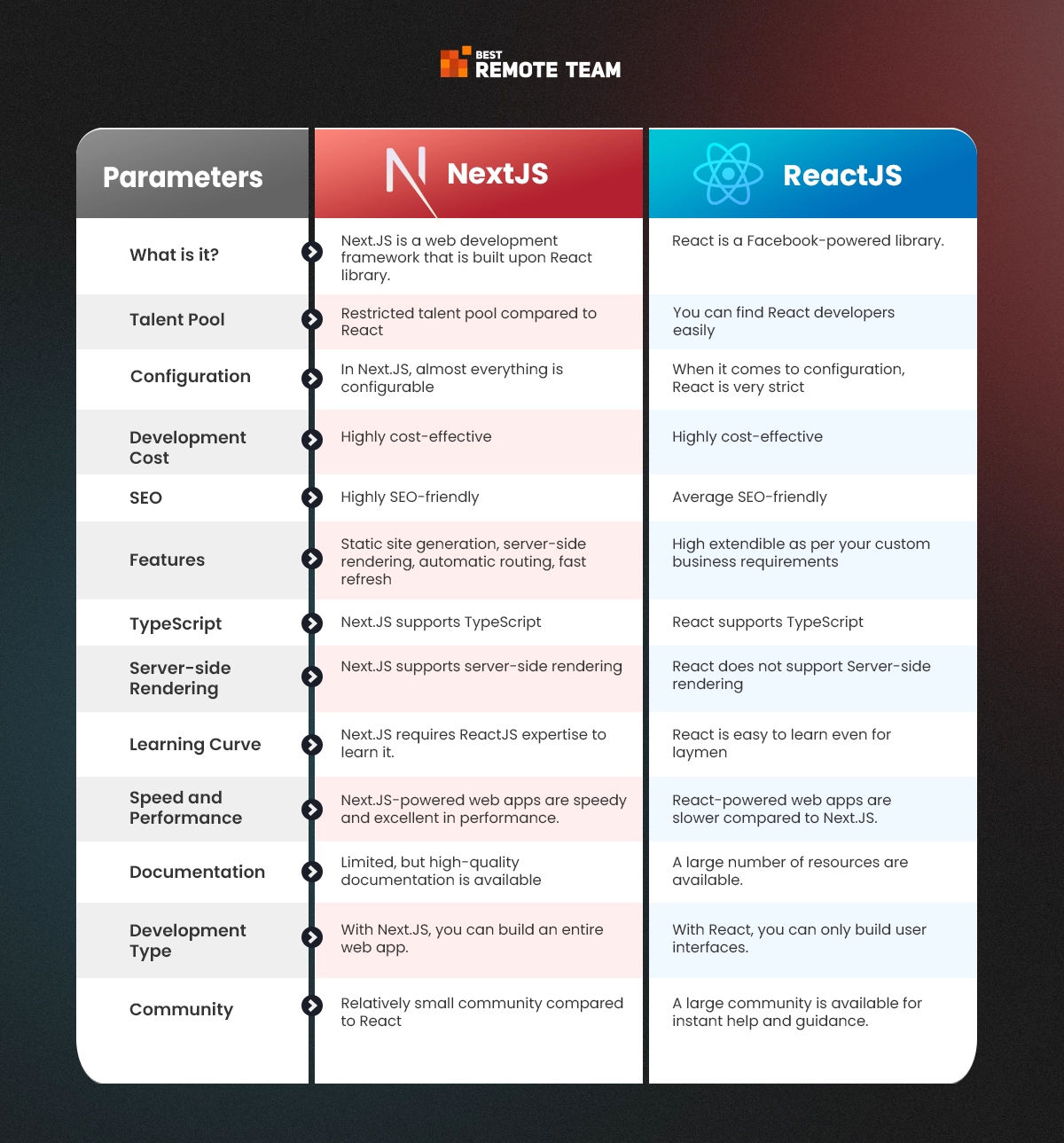
Next.js is a framework built on top of React. Think of React as the engine of a car and Next.js as the fully assembled vehicle with the engine, the chassis, the navigation, the safety systems, and the dashboard all built and ready to drive.
Next.js is a framework built on top of React. Think of React as the engine of a car…
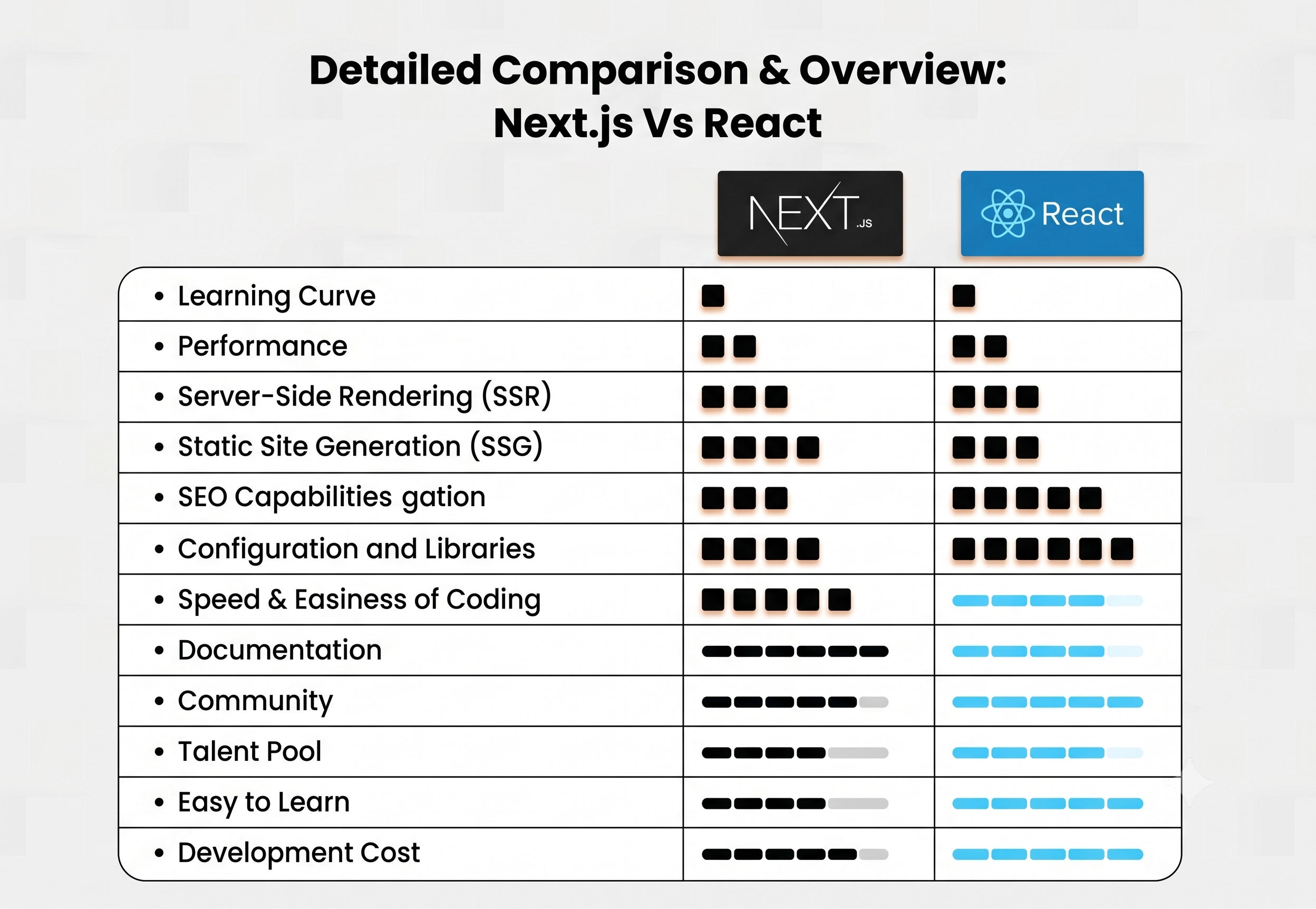
<cite index="23-1">Next.js delivers 2-3X faster initial page loads than React CSR for content-heavy pages. For any project where SEO matters, Next.js is the clear choice — no additional configuration needed.</cite>
Next.js adds everything that React leaves open:
Routing — automatic, based on your file structure
Server-Side Rendering — your pages are built on the server and delivered as readable HTML
SEO infrastructure — search engines can read your content from the very first crawl
Image and performance optimisation — automatic, out of the box
API routes — backend logic lives right alongside your frontend code
Multiple rendering strategies — you can choose how each individual page is rendered
<cite index="27-1">Next.js does not replace React. Every Next.js application is a React application. Next.js is a framework that extends React with server capabilities, routing, and production optimisations.</cite>
React gives you the components. Next.js gives you the complete production-ready foundation — with routing, rendering, SEO, and performance all built in.
The One Difference That Changes Everything for Your Business
If you remember nothing else from this blog, remember this:
React renders your website in the visitor's browser. Next.js renders it on the server before it ever reaches the visitor.
This sounds like a developer detail. It is not. It has massive implications for your business.
Here is what happens with a standard React website:
A visitor (or a Google bot) arrives at your website
They receive an almost empty HTML file
Their browser downloads your JavaScript bundle
The JavaScript runs and builds the page content
The visitor finally sees something
<cite index="25-1">Plain React ships an empty HTML shell to the browser. The JavaScript bundle downloads, executes, and renders the UI on the client. The user sees a blank screen until JavaScript finishes. Search engine crawlers may not execute JavaScript, which means invisible content.</cite>
<cite index="25-1">Plain React ships an empty HTML shell to the browser. The JavaScript bundle downloads, executes, and renders…
Here is what happens with Next.js:
A visitor (or a Google bot) arrives at your website
The server has already built the complete page
They receive fully rendered, readable HTML immediately
The page loads fast. The content is visible. Google indexes it completely.
<cite index="29-1">If your project needs to be found on Google, load fast for new visitors, or serve content to a public audience, Next.js is almost always the right choice.</cite>
For a business website, this is not a technical preference. It is the difference between a website that generates leads and one that does not.
The SEO Impact — What This Costs Real Businesses
Let us make this concrete.
Imagine you have invested in a beautiful React website. It looks stunning. The animations are smooth. Your team is proud of it. But six months after launch, you notice something alarming — your website is barely showing up in Google search results for your core business keywords.
Imagine you have invested in a beautiful React website. It looks stunning. The animations are smooth. Your team…
Why?
<cite index="24-1">For any site where organic search traffic matters, the SEO difference between Next.js and plain React is not a minor preference — it directly affects how many people find your business online. A: Yes, significantly. Next.js delivers pre-rendered HTML that search engines crawl immediately. React's client-side rendering can result in indexation delays and reduced crawlability especially for JavaScript-heavy pages.</cite>
<cite index="24-1">For any site where organic search traffic matters, the SEO difference between Next.js and plain React is…
The business consequences:
Fewer people find you through Google searches
Higher dependency on paid advertising to compensate
Competitors with Next.js websites rank above you consistently
Every month that passes, the gap widens
This is not a hypothetical scenario. It is something we have seen and fixed for real businesses who came to us after the mistake had already been made. Rebuilding a website that was built wrong from the start costs significantly more than building it right the first time.
This is not a hypothetical scenario. It is something we have seen and fixed for real businesses who…
Performance What It Means for Your Visitors
Website speed is not just a developer metric. It is a business metric.
Research shows that a one-second delay in page load time reduces conversions by up to 7%. On mobile — where the majority of your customers are browsing — that number climbs even higher.
<cite index="22-1">Next.js supports multiple strategies: SSR, SSG, ISR, and CSR. React renders entirely on the client by default. This means the initial page load shows a blank screen until JavaScript finishes loading and executing.</cite>
The result is straightforward: for most business websites, Next.js delivers a better experience to every visitor from day one — without requiring your development team to spend weeks engineering optimisations that should have been there from the start.
So When Does React Make More Sense?
We want to be completely honest with you — and honesty means acknowledging that React is the better choice for specific types of projects.
Choose React when your application:
Lives entirely behind a login. If you are building an internal company tool, a CRM dashboard, an HR management system, or an analytics platform that only logged-in employees use — Google never needs to see it. Search engine visibility is irrelevant. React's flexibility and rich ecosystem make it ideal for these complex, data-heavy applications.
Lives entirely behind a login. If you are building an internal company tool, a CRM dashboard, an HR…
Is primarily a tool, not a website. Applications that behave more like desktop software — where users log in, manage data, run complex workflows — are built differently from business websites. React's component architecture handles this kind of complexity naturally.
Embeds into an existing product. If you are building a widget, a configurator, or an interactive feature that will be embedded inside an existing platform, React's portability is a genuine advantage.
<cite index="20-1">For internal tools, admin panels, and complex line-of-business apps behind a login, a well-architected React SPA is often simpler and more than enough.</cite>
And When Should You Absolutely Choose Next.js?
The decision becomes very clear when your website or application fits any of these:
Your customers find you through Google. If organic search is part of how your business generates enquiries, leads, or sales — Next.js is not optional. It is essential.
You are building an eCommerce store. <cite index="20-1">For ecommerce, marketing websites, and content-heavy portals, Next.js usually wins thanks to built-in server-side and static rendering and strong performance defaults.</cite>
You need a business website, service page, or portfolio. <cite index="21-1">For a portfolio website or service business, Next.js is generally the better long-term option because it supports SEO and scale without sacrificing developer experience.</cite>
You want frontend and backend in one place. Next.js lets your team build API endpoints, handle form submissions, manage authentication, and serve the frontend — all from a single, unified codebase. This simplifies your architecture and reduces costs.
You want to launch fast. <cite index="20-1">Choosing the right front-end stack is not just a "developer preference" question. For many companies, it directly impacts how fast you launch new features, how high you rank in search, and how efficiently your teams can maintain complex digital products.</cite>
You want to launch fast. <cite index="20-1">Choosing the right front-end stack is not just a "developer preference" question.…
The Simple Question to Ask Before You Decide
Before you — or your development team — commit to a technology, ask this single question:
"Will real customers find this page through Google?"
If the answer is yes even for one page of your application start with Next.js.
If the answer is no for the entire application it lives behind authentication, it is a pure tool, it will never be indexed React with Vite is likely simpler, leaner, and the better fit.
<cite index="25-1">The React vs Next.js question is not "which is better." It is "do I need the features Next.js adds?"</cite>
That is the question your development partner should be asking you before writing a single line of code.
What We Do at Nitai Technologies — And Why It Matters to You
We build in Next.js for virtually every public-facing web project we take on — business websites, eCommerce platforms, service portals, landing pages, and content-driven applications.
Not because it is the most popular framework right now. Because it is the right choice for what our clients need: websites that Google finds, visitors load fast, and businesses grow from.
We build in React when a client genuinely needs a complex, authenticated application — internal dashboards, admin tools, data management platforms — where Next.js's server rendering adds complexity without adding value.
The difference between these two decisions is one conversation. A conversation that happens before the project begins — not six months after launch when the rankings aren't moving.
At Nitai Technologies, that conversation is part of our process. Before we recommend a single technology, we ask about your business goals, your audience, your growth plans, and what success looks like for your project twelve months from now. The technology recommendation comes from understanding your business — not from defaulting to whatever our team built last.
At Nitai Technologies, that conversation is part of our process. Before we recommend a single technology, we ask…
This is what you should expect from any development partner worth working with.
Before You Start Your Project — Read This
The most expensive mistake we see businesses make is not choosing the wrong technology. It is trusting a development agency that never asked the right questions before recommending one.
A web development partner worth your investment will:
✅ Ask what your customers need to do on your website — before suggesting a framework
✅ Explain the SEO and performance implications of every technology choice
✅ Be honest when a simpler solution is the right one — even if a complex one would earn more
✅ Build for your business goals, not for the agency's preferred toolbox
At Nitai Technologies, we have built hundreds of web projects across React, Next.js, PHP, Laravel, WordPress, and custom stacks — and the technology decision on every one of them started with understanding the client's business, not the agency's comfort zone.
If you are planning a web project a new website, an eCommerce store, a web application, or a rebuild and you want an honest, experienced team to help you make the right technical decisions from the start, we would love to have that conversation with you.
If you are planning a web project a new website, an eCommerce store, a web application, or a…
No sales pitch. No jargon. Just honest advice about what your project actually needs.
→ Talk to Our Web Development Team — Free Consultation
→ See What We Have Built — Our Portfolio
About Nitai Technologies
We are a full-service web and mobile application development company. We build websites, eCommerce stores, mobile apps, and digital marketing campaigns for businesses across India. Our approach is simple — understand your business first, recommend the right technology second, and build something that genuinely grows what you have worked hard to create.
We are a full-service web and mobile application development company. We build websites, eCommerce stores, mobile apps, and…
Have a question about this blog? Reach us at info@nitaitechnologies.com