How to Choose the Right Web Portal Development Company for Your Business in India
Free Consultation
Talk to Our Experts
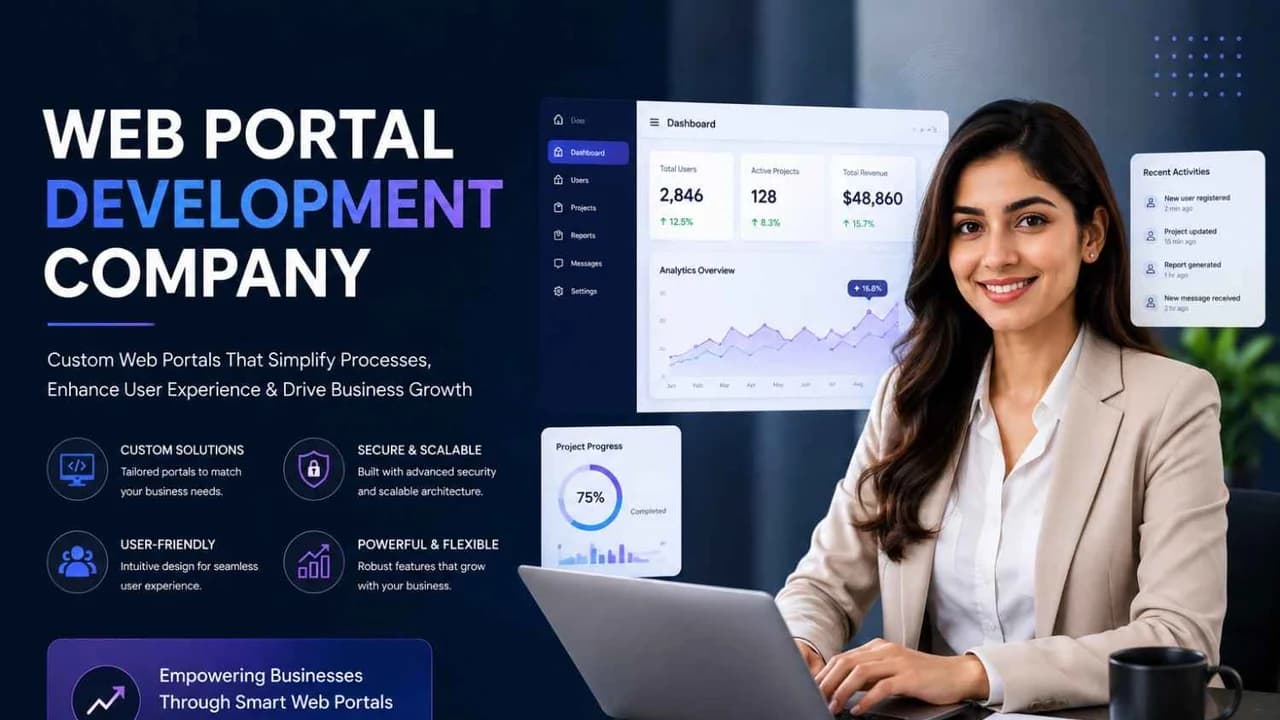
Why Most Web Portal Projects in India Fail And How to Pick a Company That Won't Let Yours
Here's a problem we see repeatedly: a business invests ₹5–10 lakhs in a web portal, launches it three months behind schedule, and six months later it's barely used. The vendor delivered a portal but not a solution.
At Nitai Technologies, we've built web portal development services for healthcare networks, logistics companies, educational institutions, real estate…
What Is Web Portal Development and Why Does Your Business Need It?
- • Customers need a self-service interface to track orders, raise tickets, download invoices, or manage accounts without calling your team.
- • Internal teams need a centralised dashboard to manage inventory, approvals, reports, or workflows across departments.
- • Partners or vendors need a controlled access point to submit documents, check status updates, or communicate without email chains.
- • A marketplace or aggregator model needs multiple user roles buyers, sellers, admins operating on the same platform with different permissions.
The common thread across all of these is that a portal replaces manual, fragmented processes with a structured,…
The 6 Types of Web Portals Indian Businesses Most Commonly Need
1. Customer Portal
2. Vendor / Supplier Portal
3. Employee Self-Service Portal
4. Partner / Dealer Portal
5. Learning Management Portal
6. B2B Marketplace / Aggregator Portal
From Our Experience at Nitai Technologies: The most common mistake businesses make when approaching web portal development is…
What to Look for in a Web Portal Development Company
They Start With Your Workflow, Not Their Template
A credible web portal development company will spend the first one or two sessions mapping your user journeys…
They Have Relevant Industry Portfolio Work
Ask specifically for portal projects not just websites. Look at the complexity: does the portfolio show multi-role dashboards,…
They Are Transparent About Technology Choices
The right tech stack for web portal software development depends on your use case — React and Node.js…
They Give You a Realistic Timeline and Scope
A web portal development services company that quotes 4 weeks for a multi-role portal with payment integration and…
They Include Post-Launch Support in the Contract
A portal is not a static asset. It needs bug fixes, user feedback-driven iterations, security patches, and performance…
The Web Portal Development Process What It Should Look Like
- 1. Discovery and Requirement Mapping (Weeks 1–2): We map every user role, every workflow, every data input and output. This phase produces a detailed scope document no development starts without it.
- 2. Information Architecture and UX Design (Weeks 2–4): Wireframes for every key screen, reviewed and approved before visual design begins. Navigation logic is validated against real user journeys.
- 3. Visual Design (Weeks 4–6): High-fidelity mockups aligned to your brand. We design for mobile-first India is 78% mobile traffic.
- 4. Frontend and Backend Development (Weeks 6–14): Parallel development tracks frontend engineers build the UI while backend engineers build APIs, database structure, and business logic.
- 5. Integration and QA (Weeks 12–16): API integrations (payment gateways, ERP, CRM, third-party services), security testing, load testing, and QA across 12 device/browser combinations.
- 6. UAT and Launch (Weeks 15–18): User acceptance testing with your internal team, feedback iterations, final deployment, and server configuration.
- 7. Post-Launch Support (Months 1–3): Bug monitoring, performance tracking via analytics, and a structured feedback cycle for iteration priorities.
The actual timeline varies by complexity. A portal development services project for a 3-role B2B platform with payment…
How Much Does Web Portal Development Cost in India?
- • Basic portal (single user role, no payment integration, standard workflows): ₹1,50,000 – ₹3,00,000
- • Mid-complexity portal (2–3 user roles, API integrations, reporting dashboard): ₹3,00,000 – ₹7,00,000
- • Enterprise portal (multi-role, ERP/CRM integration, custom workflows, high-load architecture): ₹7,00,000 – ₹20,00,000+
- These ranges apply to custom web portal development services built from scratch. Template-based portals cost less upfront but carry higher long-term customisation costs as your requirements evolve.
- A web portal development company that gives you a fixed quote before mapping your requirements is guessing and that guess will cost you more in change orders than if they'd scoped it properly from the start. Budget transparency from day one is a basic professional standard.
The Right Portal Partner Makes the Difference Between a Tool and a System
A web portal built without a proper discovery process, clear workflow mapping, and post-launch support is a liability,…
After 9 years and 2,550+ delivered projects, Nitai Technologies has built custom web portal development services for healthcare,…
If you're planning a portal project and want to understand scope, timeline, and realistic cost before committing to…
Frequently Asked Questions
Question
What is the difference between a website and a web portal?
⌄
Question
What is the difference between a website and a web portal?
Answer
A website delivers information to visitors. A web development portal delivers functionality to authenticated users they log in, take actions, access personalised data, and interact with other users or systems. A portal has user roles, permissions, workflows, and data management. A website typically does not.
Question
How long does web portal development take?
⌄
Question
How long does web portal development take?
Answer
A standard web portal development company project takes 10–16 weeks for a mid-complexity portal. Simple single-role portals can launch in 6–8 weeks. Enterprise portals with ERP integrations and high-volume data handling run 20–30 weeks. Timeline depends on scope clarity, not just technical complexity projects with poorly defined requirements almost always run over.
Question
Which technology is best for web portal development?
⌄
Question
Which technology is best for web portal development?
Answer
There's no single answer. For real-time, data-heavy portals React and Node.js. For structured workflow and admin systems Laravel or Django. For content-rich portals with manageable complexity WordPress with custom development. A good web portal software development team recommends based on your use case, not their preference.
Question
Can the portal be integrated with our existing ERP or CRM?
⌄
Question
Can the portal be integrated with our existing ERP or CRM?
Answer
Yes, in most cases. Standard portal development services include REST API integrations with systems like SAP, Zoho, Salesforce, Tally, and custom in-house platforms. The feasibility depends on whether your existing system has a usable API this is one of the first questions we check in the discovery phase.